1.7
version on Play
A native Jetpack Compose client for SIMA and SIMA Inglés, Universidad de Cartagena’s Moodle platforms: tasks by urgency, grades, calendar and local alarms before every deadline. From idea to production on Google Play, with its own landing page and internal admin panel.
Moodle is the course platform behind thousands of universities and schools. It works — but on a phone it’s usually a desktop-first website, and it doesn’t warn you about anything in time. Deadlines get missed not for lack of effort, but because nobody opens five courses every day to check.
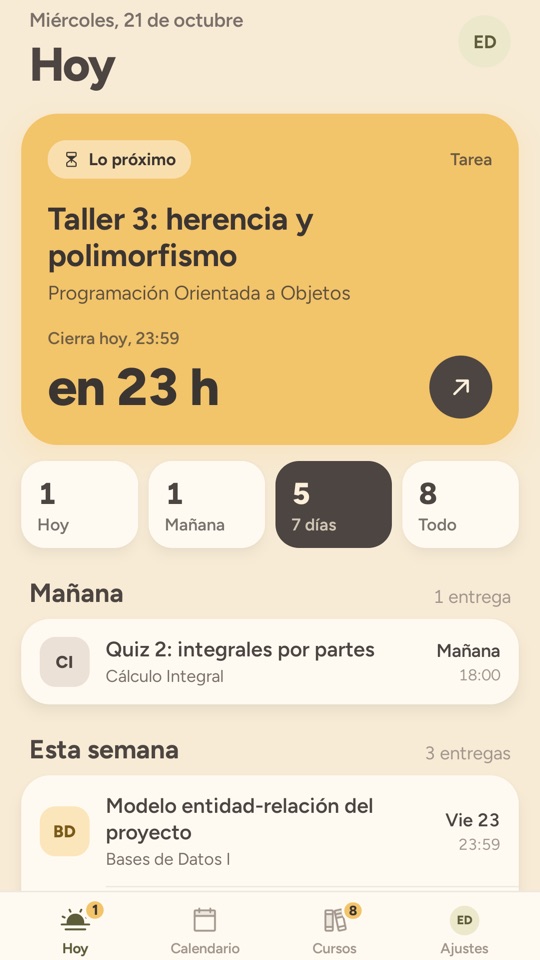
It started as the app I wanted for SIMA, my university’s Moodle: open it and know in three seconds what’s due today, tomorrow and this week. Today it works only with Universidad de Cartagena: SIMA, SIMA Inglés and the SMA.
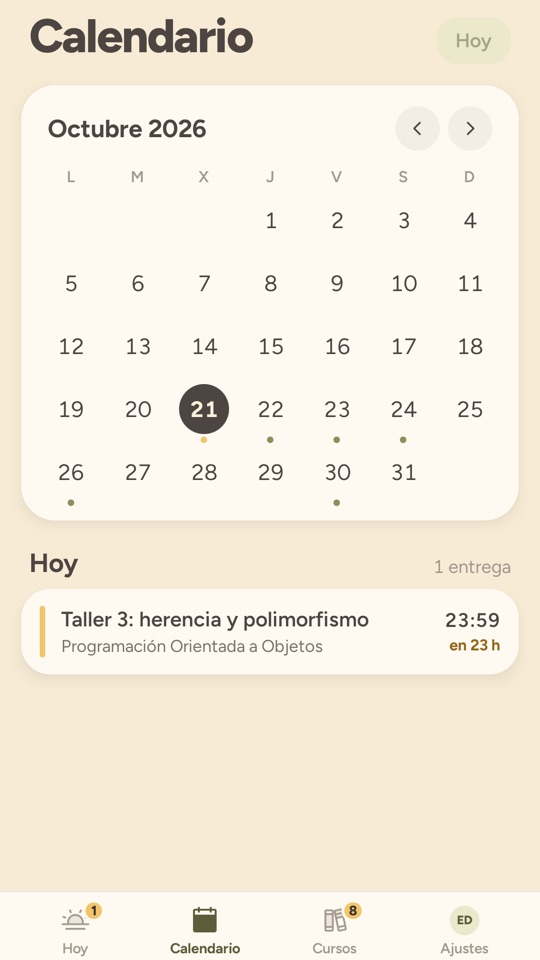
Today groups pending work by urgency (today / tomorrow / this week / later). Calendar shows the month with the days that have deadlines. Courses opens each subject in three tabs: pending work, content, and grades with a progress bar.
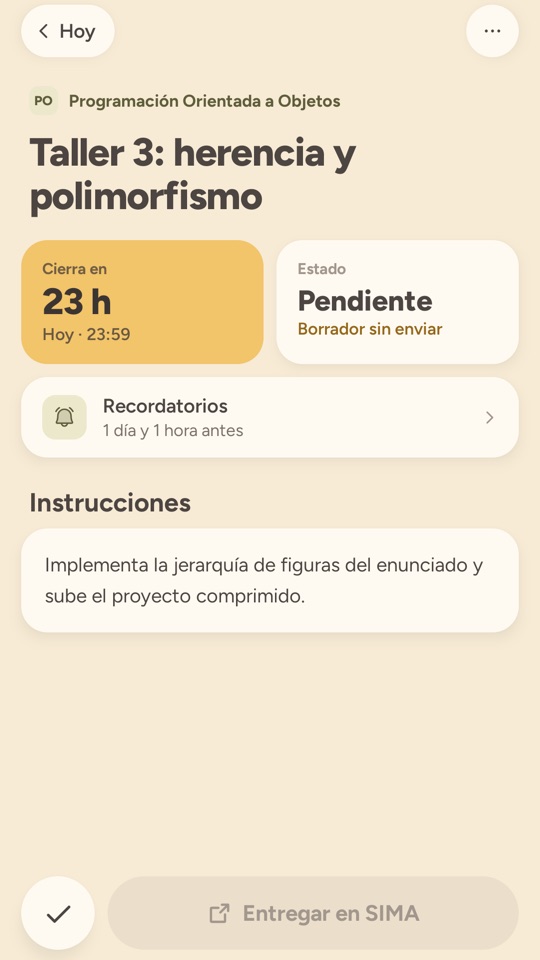
Tapping an activity opens it inside the app, in an already-authenticated WebView — no logging into Moodle again.
Server-less alarms. Reminders (1 day, 4 h, 1 h, 15 min or on time) are scheduled on the phone itself with exact alarms. If the user doesn’t grant Android 14+’s exact-alarm permission, the app falls back to an inexact alarm instead of going silent. No backend to maintain and no student data travelling to a server of mine.
Encrypted credentials and a session that doesn’t drop. Token and credentials are stored encrypted on the phone. When the Moodle token expires, the session silently requests a new one: the student logs in once.
Offline first. Courses and events are stored in a local database; the app reads from it and the network only syncs. Opening the app doesn’t depend on Moodle responding quickly.
The product around the app. An Astro landing page with a waitlist, and an internal panel (Fastify + MongoDB + React) with roles, write auditing and the tester tracking Google requires — 12 people for 14 days — before a new app can go to production.
That shipping is a project of its own. Writing the app was half of it; the other half was the closed test, the privacy policy, the store listing, the permissions Google reviews one by one, and getting real testers to use it for two weeks straight.
And that the best product is often the one that fixes something that bugs you. When you’re the user, you don’t have to guess what matters.